Expanding the Window of Possibility
How GSPP alumna Jaimie Lusk helps veterans—and others—build resilience and rediscover purpose
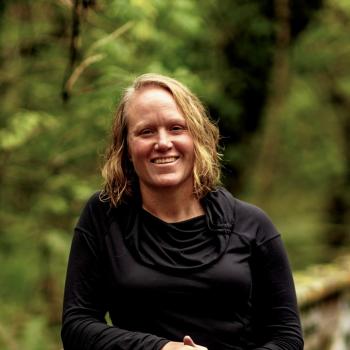
For Jaimie Lusk (PsyD ’15), the road to becoming a psychologist was anything but linear. Before arriving at the University of Denver’s Graduate School of Professional Psychology (GSPP), she had already served as a U.S. Marine Corps officer during Operation Iraqi Freedom, searched for direction after returning home, and moved through a series of unexpected roles that included professional cycling and teaching. What she carried with her from those experiences—questions about trauma, purpose, and what it means to rebuild a life after hardship—would eventually shape her career.
After leaving the military, Lusk found herself navigating a period of uncertainty. For a time, she worked as a bicycle messenger in Denver and immersed herself in that community, even winning the Bicycle Messenger World Championships. The experience reflected her adventurous spirit, but it also left her searching for a deeper sense of purpose. Brief chapters teaching in Denver Public Schools and attending seminary followed before she eventually applied to GSPP’s PsyD program.
The decision was not the result of years of planning. In fact, she recalls arriving at the interview day without much preparation—but quickly realizing she had stepped into a room filled with people deeply committed to the field.
“I realized how much I didn’t know,” she says. “People really want to be here…people really have done the research.”
That moment marked the beginning of a transformative chapter. At GSPP, Lusk immersed herself in her training and began to rethink how she understood human behavior and psychological change.
“What I think it gave me that I will value the rest of my life is my philosophy of what it means to be human,” she explains. “I get to be curious, I get to be compassionate, and I get to help somebody in front of me understand [themselves].”
Rather than centering diagnosis, her training encouraged her to look more closely at how thoughts, emotions, and behaviors operate within a person’s life.
“They really taught me not to see labels,” she explains. Instead, she learned to help people understand the patterns behind their experiences and how attempts to escape painful emotions can sometimes create new challenges.
Several faculty members played an important role in shaping that perspective. Professors such as John McNeil challenged her thinking in seminars, encouraging deeper curiosity about human behavior. Clinical supervisor and Dean Emeritus Peter Buirski helped her slow down and focus on emotional experience rather than complicated interventions. Lusk also credits sport psychology professor Artur Poczwardowski as a model of leadership and mentorship, noting how his approach created an environment where students genuinely wanted to perform their best.
During her time at GSPP, Lusk also connected with the Department of Veterans Affairs, where she began working with fellow veterans. That work allowed her to integrate her personal experiences with her professional training in a meaningful way.
“I didn’t know how I was going to make sense of my service,” she says. “But as I started working with vets…it started to be able to be a place I could make meaning and use it for good.”
For more than a decade, Lusk has specialized in treating post-traumatic stress disorder (PTSD) and moral injury among veterans. Through that work, she has witnessed both the profound burdens many veterans carry and the resilience they bring to the healing process.
“I think veterans are some of the most [remarkable] people,” she says. “There’s courage, there’s grit, there’s honor, courage, commitment—and we’ve asked them to do incredibly hard things and carry the weight of moral distress that the rest of the population can ignore. So, it’s a real honor to work with people who are carrying [that] for our whole society.”
Over time, that work has also shaped how Lusk thinks about resilience. For her, resilience is not simply the ability to endure hardship, but the ability to restore and direct one’s energy toward what matters most.
“If there’s some sort of vitality tank inside of us,” she explains, resilience means “the ability to patch up the holes, the ability to fill it up, and the ability to direct that vitality in valued directions.”
In recent years, Lusk has begun exploring new ways to help people rebuild that sense of vitality—including integrating nature and outdoor adventure into her therapeutic work.
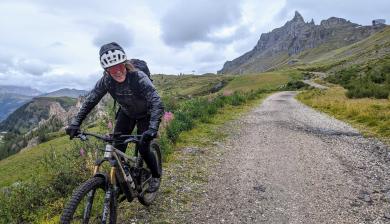
Lusk increasingly draws on activities like surfing and mountain biking as ways to help people engage with fear, challenge, and resilience in real time. Surfing, she explains, offers a powerful metaphor for how individuals gradually expand their capacity to face difficult experiences.
“It’s not perfectly safe—there’s actually quite a bit of risk in surfing—but you can learn how to manage it,” she says. “You’ve got to know the ocean, know the conditions, know your abilities.”
Just as surfers venture farther into the water as their skills grow, she sees trauma recovery as a similar process of stretching what psychologists call the “window of tolerance”—the range in which a person can respond thoughtfully rather than react automatically. In nature, people can experience fear alongside awe, joy, and camaraderie, helping separate fear from actual danger.
“Out there, we can approach scary things in real time and learn to manage risk,” she says.
That same concept connects Lusk’s work in trauma therapy with the world of elite performance. She describes healing and peak performance as “two sides of the same coin,” both centered on expanding a person’s ability to remain steady under pressure.
“Part of trauma therapy is wedging open that window of tolerance so you find yourself in more and more situations where you can respond instead of react,” she says.
Elite athletes train in much the same way, expanding the range in which they can perform at their best even under intense pressure.
“Increasing the range in which we can respond instead of react is true for both domains,” she says.
That philosophy now shapes a new project Lusk is helping lead: Wild Resilience, a retreat that blends performance psychology, nervous system awareness, and outdoor adventure. Hosted through the Modern Elder Academy, the retreat brings together participants navigating life transitions and invites them to explore resilience, purpose, and growth alongside experienced athletes and guides.
Lusk hopes participants leave with renewed perspective and support for the path ahead. “A little vision, a little resilience, and a little ‘friends for the journey’,” she says.
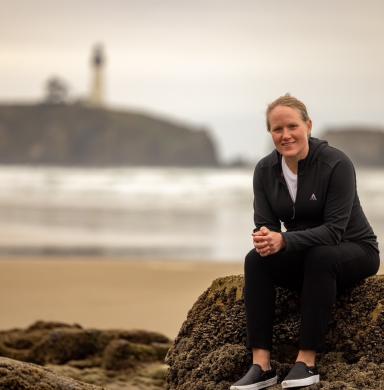
As the March highlights Women’s History Month, Lusk also reflects on how her experiences as a woman in the military, in elite sport, and in psychology have shaped the way she leads and practices today. Earlier in her career, she says, she often felt that qualities like compassion and emotional awareness were undervalued in more traditionally masculine leadership environments.
Over time, however, she has come to see those qualities as strengths.
“I’ve learned from strong women how to balance compassion and truth-telling—compassion and boundaries,” she says. “It can be validating, comforting, and reassuring, but it can also protect, provide, and guide.”
That balance—fierce compassion paired with clear boundaries—now shapes the way she works with clients, mentors others, and approaches leadership in her field.
For Lusk, the journey that brought her from military service to sport to psychology continues to evolve. But the thread running through it all remains the same: helping people expand what they believe is possible for their lives.