Mentality Wins: Dr. Jonathan Jenkins on Performance and Peace

Before he was working with professional athletes, Dr. Jonathan Jenkins (PsyD ’13) was facing a simpler—but defining—question: where did he truly belong in healthcare?
“I was pre-med and psychology,” he recalls. “After doing most of the pre-med track, I’d wrestle with whether I liked blood or not… and I found out that I don’t like blood.”
That realization, paired with the lasting impact of a childhood pediatrician who helped him navigate severe asthma with empathy and calm, redirected his path. “I always loved the idea of getting to know people, helping them through tough and challenging situations, and helping them figure out what’s going to empower them and move them forward.”
That vision found a natural home at the University of Denver’s Graduate School of Professional Psychology (GSPP). Dr. Jenkins was drawn to DU in part because of its emphasis on diversity, including the diversity sequence that was part of the curriculum during his time in the program. What stood out to him was not just the clinical training, but the emphasis on developing the clinician as a whole person. “They prioritized not only a diversity and integration of therapeutic modalities, but also the development—both personal and clinical—of the clinicians throughout the program,” he says.
Dr. Jenkins describes his time at GSPP as foundational in shaping how he understands people across the lifespan. The program encouraged students to expand beyond their initial interests, offering exposure to different populations, perspectives, and approaches that continue to inform his work today.
Equally impactful was the sense of community. Dr. Jenkins recalls a cohort that pushed one another toward excellence while remaining deeply supportive. “You felt like people were invested in you and wanted you to be successful—and that’s not always the case in grad school,” he says. These relationships, many of which he maintains today, became an integral part of his professional and personal journey.
Although Dr. Jenkins began his career focused on child and adolescent mental health, his eventual pivot into sport psychology can also be traced back to GSPP. Exposure to classmates taking electives in the Master’s in Sport and Performance Psychology program sparked his initial interest in the field. Listening to them discuss their work, he became intrigued by how sport psychology could extend beyond athletics into broader clinical care. “They were able to utilize sport psychology not only to help athletes and coaches, but also to integrate it into their traditional psychology work,” he explains, particularly with young clients whose identities are often shaped by extracurricular pursuits.
At the time, Dr. Jenkins did not set out to become a sport psychologist. Instead, he carried those ideas with him—curious but grounded in his primary focus. The turning point came later at Massachusetts General Hospital (MGH), where he now serves as an outpatient psychologist working with children and adolescents.
Early in his time there, a supervisor asked if there was anything else he wanted to explore beyond child psychology. Dr. Jenkins hesitated. “There was a voice in my head that said, don’t say it… and then there was a voice that said, just mention it,” he recalls.
He mentioned sport psychology—and unexpectedly, that moment changed everything. The supervisor connected him to work with the Boston Red Sox and helped him build competency through training and supervision. “It went from having these experiences with classmates… to feeling supported enough to mention that in a clinical space,” he says.
Soon after, an opportunity with the New England Patriots followed, marking the next phase of his career. Today, Dr. Jenkins supports athletes across both organizations, helping them navigate injury recovery, onboarding, career transitions, and the full spectrum of stress—from performance challenges to major life milestones, such as marriage and parenthood.
“A lot of people think psychologists help when times get tough,” he says. “But one of the great things I learned about sport psychology is, [it’s] human support during good times as well. You’re not sick, but you can be healthier.”
Despite working with elite athletes, Dr. Jenkins remains grounded in how he views his role. He is quick to note that he stepped into organizations already operating at the highest level—teams “firing on all cylinders,” with strong leadership, established systems, and world-class talent. “I’m not the engine that makes the car move,” he says. “I’m just there to support and shift when necessary.” For Dr. Jenkins, that mindset reflects both humility and a deep respect for the collective effort behind elite performance, as well as for team cultures that have become increasingly open to mental health support.
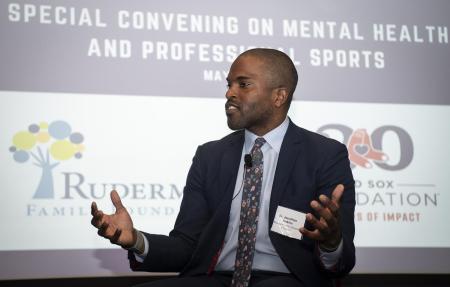
In recognition of Mental Health Awareness Month, Dr. Jenkins reflects on how the conversation around mental health—particularly in high-performance environments—has evolved. Where mental toughness was once defined by pushing through at all costs, he now sees a more balanced and sustainable definition taking shape.
“Mental toughness has previously been associated with perseverance… but for a lot of people that doesn’t work,” he explains.
Instead, he emphasizes awareness and adaptability—knowing when to push forward and when to step back. “If you want to be the fastest car on the track, you’ve got to hit the brakes and the gas,” he says.
This shift is especially important for younger generations. With social media and global comparison, many young athletes are measuring themselves against peers they will never meet, often losing perspective on their own progress. “You now have people… comparing themselves to so many people… and it takes them out of where they are now,” Dr. Jenkins notes.
Alongside his work at MGH and with professional teams, Dr. Jenkins founded his private practice, Mental Fitness & Psychotherapy, LLC, in 2016. The practice reflects a core philosophy that has shaped both his clinical work and personal life: the pursuit of peace.
“I always think of the word peace,” he says. “Not that everything around you is calm—but that there’s a sense of calm inside of you.”
In practice, that means helping clients—particularly high achievers—pursue excellence without losing themselves along the way. “They can do it and be themselves… they don’t have to give parts of themselves away,” he explains.
Central to Dr. Jenkins’ work is the concept of mental fitness—approaching mental wellbeing with the same intention as physical health. He sees a clear imbalance: people invest significant time in maintaining their bodies, but far less in habits that support their emotional and psychological resilience. “There should be no difference in how we view physical fitness than how we view mental health,” he says.

Dr. Jenkins brings this philosophy to his recent book Mentality Wins: The Athlete’s Playbook for Thriving in Sport and Life, co-written with Dr. Kimberly O'Brien. The book offers practical, accessible strategies for building mental strength through short, repeatable routines that can be applied in sports and other high-pressure environments. Organized around four pillars—focus, flow, finish, and flourish—the book guides readers from preparation to performance to long-term wellbeing, reflecting his broader mission to help people rebalance the time and energy they devote to their mental health.
For Dr. Jenkins, however, the most meaningful aspects of his work are often the most human. He recalls receiving an unexpected message from a former patient years after working together—a reminder of the lasting impact of simply showing up with consistency and care. “It stopped me in my tracks,” he says. Moments like these reinforce his belief that therapy is not always about perfect interventions, but about presence and connection.
That perspective continues to guide his work. Whether in a hospital setting, on the sidelines, or in the therapy room, Dr. Jenkins remains focused on what drew him to psychology in the first place: showing up, staying present, and helping people move forward.
Because in the end, his work is not just about performance—it is about helping people build lives they can sustain and a sense of peace they can carry with them, wherever they go.