Nyah Cubbison Helped Build the Kinesiology Major She Will Now Graduate From
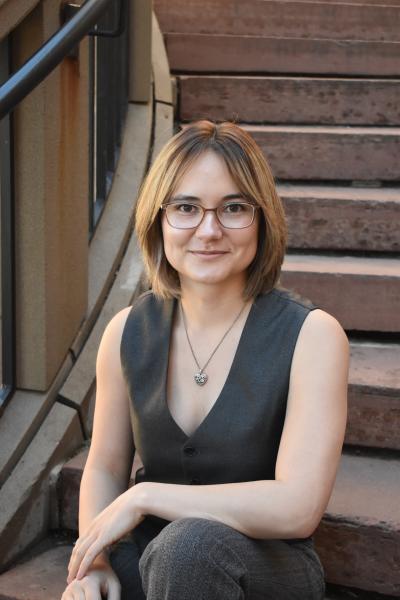
When Nyah Cubbison first arrived at the University of Denver, she was not planning to become a kinesiology student. In fact, she had not grown up playing sports or thinking of exercise as a central part of her life.
“I never worked out as a kid. I never did any sports,” she said. “So it’s really weird if you tell people from my past that I’m studying kinesiology.”
But during high school, Cubbison began working out with her stepfather, a former collegiate baseball player, while she was training for boot camp. At the time, she was not even planning to attend college. What happened next changed the direction of her life.
“I had a huge shift in my mental health from exercising,” she said. “My physical health too, but really just the mental clarity that I had from exercising regularly was like a complete flip — total life changer.”
That experience gave Cubbison a new sense of purpose. She wanted to help others understand the psychological impact of physical activity, especially people who may not have easy access to physical activity in the first place.
She came to DU as a psychology major and took a foundations course in kinesiology during her first quarter. The course introduced students to career paths in sport coaching, fitness, health and wellness, and other kinesiology-related fields. Cubbison was immediately drawn to the possibilities. But there was one problem: at the time, kinesiology at DU was still a minor, not yet a major.
“I was getting really inspired by all of these roles, but you really need a bachelor’s or higher in kinesiology to reach any of those,” she said.
When Cubbison told Sara Campbell, teaching assistant professor and co-director of the kinesiology program, that she was considering transferring, Campbell connected her with Brian Gearity, professor and co-director of the program. Cubbison soon learned that the major had already been in development; what the program needed was evidence of student interest.
So Cubbison helped provide it.
She started a petition, gathered signatures from students interested in a kinesiology major and wrote a letter sharing her own testimony. She pointed not only to her own interest, but also to the broader need at DU.
“With DU being a Division I school, it’s crazy that they didn’t have a kinesiology program,” she said.
The major was approved in 2023. Cubbison stayed at DU. And this June, she will graduate as one of the first students from the undergraduate Kinesiology and Sport Studies program she helped advocate for within the Graduate School of Professional Psychology.
“It feels very full circle, very fulfilling and also very rewarding,” she said. “You can look at it from kind of tunnel vision on just my journey — where I’m getting the degree that I advocated for — but also all these other people are getting the degree that I helped advocate for.”
Cubbison is also completing her master’s in research psychology through the College of Arts, Humanities and Social Sciences, finishing the 4+1 program in four years rather than five because of concurrent enrollment credits she earned in high school. She did not originally imagine herself pursuing research. In fact, during her first two years of college, she did not think research was for her.
Then a psychology professor noticed her potential and encouraged her to consider it. Cubbison joined Daniel McIntosh’s Mind and Body Lab and began exploring ways to bring kinesiology into psychological research. Her early work focused on group fitness instructors and the emotional labor they experience in the workplace. Through that work, and with Gearity’s guidance, she discovered qualitative research.
“I fell in love with qualitative because that’s the working-with-people-ness that I wanted,” she said.
Her internship through the kinesiology program helped sharpen that focus even further. Cubbison worked with Back on My Feet, a nonprofit that provides exercise opportunities for people experiencing homelessness, people in recovery and others connected with transitional living programs. Volunteers meet participants early in the morning to run, walk or jog together, building community through movement. The organization also provides exercise clothing and shoes.
Cubbison led wellness workshops and volunteered three mornings a week. The experience transformed the way she thought about research.
“That is what really made me realize [that] I want to shift my research to be community-based, where I’m on the ground with the people I’m trying to help and use my privilege to uplift,” she said.
Her master’s thesis now focuses on understanding the barriers and supports to physical activity for people experiencing homelessness. For Cubbison, the goal is not research for research’s sake. It is research that returns something meaningful to the communities it studies.
“I want to do things that are actually making a difference, tangibly,” she said. “Knowledge production, but with communities.”
Throughout her time at DU, Cubbison said the kinesiology faculty helped her find and shape her path. Campbell’s teaching, DEI focus, and mentorship inspired her to think about the kind of professor she might one day become. Gearity taught her qualitative methods, introduced her to conferences and professional connections, and modeled a version of academia that still leaves room to be human. Beau Houston, visiting assistant professor, gave her what Cubbison describes as one of the most valuable lessons of college: how to lead by recognizing the strengths of others.
“I learned that I thrive in a leadership position,” Cubbison said. “It’s super important to put value on what an individual’s skills are when you’re working in a group.”
Now, Cubbison is preparing for her next chapter at Penn State, where she will pursue a dual PhD in exercise psychology and behavioral neuroscience within the university’s kinesiology program.
The opportunity came unexpectedly, after Gearity shared a posting for a fully funded position with a faculty member whose work aligned closely with Cubbison’s interest in community-based physical activity research. The fit, she said, was immediate.
“It just really fell out of the sky and into my lap,” she said. “I didn’t even have to think really about the decision. In comparison to the other programs I was trying to fit into, this one was just perfect.”
Cubbison hopes to continue studying access to physical activity, especially for communities that have historically been left out of conversations about health and wellness. She also wants to make research more accessible, moving beyond academic jargon so findings can reach the people who may benefit from them most.
“I hope to make waves in the research on exercise access,” she said. “And I hope to make a difference in the communities that I’m doing this research with.”
Looking back, Cubbison describes her DU and GSPP experience as fulfilling and inclusive. She entered a young program and helped it grow. She tailored her education across disciplines, connecting movement, mental health and community impact in a way that reflected her deepest values. And again and again, when the path she needed did not yet exist, she helped create it.
For Campbell, Cubbison’s journey reflects not only her own drive, but also the promise of DU’s growing kinesiology program.
“Nyah is everything she claims to be — a scholar, a leader, an advocate, an artist, and most importantly, an excellent human being,” Campbell said. “Her growth over the last four years showcases how far our kinesiology students can fly if they have passion, motivation, and curiosity. The best part is that her journey is just beginning. I can’t wait to see how many lives she changes for the better.”
In her personal life, Cubbison said her family and friends often tell her the same thing when she feels overwhelmed: “You’ll figure it out. You always do.”
At DU, that became more than reassurance. It became a pattern. Cubbison figured out how to stay at the university she loved. She figured out how to help turn a minor into a major. She figured out how to build an academic path around access, purpose and service.
And now, as she prepares to graduate, she leaves behind more than her own accomplishments. She leaves behind a growing program — and a path for future students to follow, expand and make their own.