Zainab Alyasseri: Carrying Forward a Legacy of Survival, Service and Belonging
Before Zainab Alyasseri found the words for the work she wanted to do, she returned to the place that helped her understand why it mattered.
In 2023, one year after earning her undergraduate degree, Alyasseri traveled to Iraq, where her family is from. The trip was spontaneous, but returning as an adult gave her a new way to understand identity, family history and the trauma carried across generations. Her parents had come to the United States as refugees in the late 1990s, and as she sat with their story alongside her own, the connection became clear.
"Everything traced back to trauma and psychology," she said.
That realization led her to search "trauma psychology master's program." The University of Denver appeared in the results. After attending an information session led by Gwen Mitchell, PsyD, professor and co-director of the Master's in International Disaster Psychology: Trauma and Global Mental Health program at the Graduate School of Professional Psychology, she felt an immediate pull.
"I remember just thinking, wow, this aligns exactly with what I was looking for."
Choosing DU meant following purpose over practicality. Alyasseri is from Louisville, Kentucky, and had considered a program in Chicago, far closer to home. She had no family in Denver and had never set foot in the city.
"I had absolutely no reason to come to Denver," she said. "It was the program."
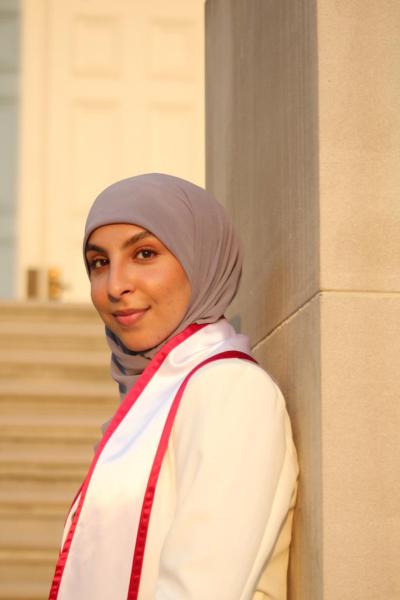
This June, she will graduate with her master's degree—a milestone she refuses to claim as hers alone.
"It's my family's, my parents' milestone. It's my community's milestone. It's my country's milestone," she said. "To know that three decades ago my parents were living in a tent in the middle of the desert in Saudi Arabia not knowing where their fate was going to take them, to now I'm graduating from a private university with my second degree, with a graduate degree, is huge. It's revolutionary."
Alyasseri is a first-generation Iraqi-American, the eldest daughter and the first in her family to navigate many of the spaces she has entered. Arabic was the language of her home growing up, and her parents made sure she and her siblings kept it. Later, studying Spanish as an undergraduate, she began to understand language not just as a skill but as a form of access—especially in trauma and disaster psychology.
At GSPP, that understanding became practical. Alyasseri served as a clinic assistant for both years of the program and as a student clinician at the Trauma & Disaster Recovery Clinic (TDRC). The dual role let her support classmates behind the scenes while also working directly with clients.
"I wasn't just here as a student," she said. "I could also pay it forward to help my classmates."
Her work at the clinic made the stakes of language access concrete. Her first client was an Arabic speaker, and because Alyasseri was available, that person did not have to wait weeks for care. There is a difference, she learned, between working with an interpreter and sitting across from someone who shares your language and your history.
"It's a world of a difference," she said.
That lesson deepened during her internship with SolidarityNow in Athens, Greece, a nongovernmental organization serving asylum seekers, migrants and refugees. Alyasseri worked at the reception desk, interpreting in Arabic and helping people communicate their needs to staff. Many arriving at the organization were navigating barriers to food, housing, safety and legal protection—still fighting to survive, with little room left for emotional or psychological care.
The work was deeply personal. Inside the building, she could use her language and training to create a moment of safety. Outside, as an Iraqi-American Muslim woman who wears hijab, she felt how quickly people are reduced to assumptions about identity and belonging. Those walking through SolidarityNow's doors faced those same assumptions every day, but without the privilege she carried—a U.S. passport, a graduate education, the ability to leave.
That contrast made the work feel even more personal. Many of the people she met were Arabic-speaking refugees and asylum seekers who, in another time or circumstance, could have been part of her own story.
"The people coming in could have been my family," she said.
In Athens, she learned that care is not always about intervention. Sometimes it is about presence—listening, interpreting, welcoming someone in their own language in the middle of uncertainty.
"It was the lived experience of just being a witness," she said.
She returned from Greece with a clearer sense of the clinician she hopes to become: one committed to culturally and faith-informed care that meets people where they are. For Alyasseri, that means making mental health more accessible not only through language and resources, but through approaches that communities can trust. She hopes to provide psychoeducation in ways that help people name and make sense of their lived experiences without feeling that care is being imposed from the outside.
"People can't put terms to their lived experiences, and there's a huge difference in that," she said.
It also means helping others see that they belong in the field. As an Arab, Muslim and first-generation student, Alyasseri entered the program knowing there were few people with her identities in mental health. At first, she kept herself small. But at GSPP, she found that her perspective was not only welcomed—it was needed.
"We deserve to step into these spaces and we are welcomed. We will be heard by the right people, and together, we will create change."
Mentors shaped that growth: Mitchell; Laura Ramzy, PhD, clinical associate professor in the program; and Tiamo Tamale, PhD, assistant professor and director of TDRC, who served as Alyasseri's instructor and clinical supervisor. Alyasseri had read Tamale's bio before applying and said it was part of why she chose the program. Through their work together, Tamale saw Alyasseri bring that same presence and purpose into her work with others.
“Clinically, I have seen Zainab meet her clients both different from and similar to herself with powerful authenticity, deep empathy and balanced acceptance while challenging them with skillfulness,” Tamale said.
Tamale also described Alyasseri as calm, inquisitive, organized and deeply collaborative, someone who brings “drive, altruism, and an innovative approach to problem-solving” to the work. That combination of steadiness and purpose became part of what Alyasseri carried through the program—and what she hopes to bring into her future practice.
Over time, Denver became more than the city she came for school. Through clinical work, community, and mentorship, she found footing in a place that had once been entirely unfamiliar and more confident that her identities were not separate from the work she hoped to do, but central to it.
Asked to describe her GSPP experience in a few words, Alyasseri doesn't hesitate: grounding, humbling, blessed. "Every piece of feedback, every not-so-perfect grade is serving something—it's building something bigger," she said. "As a Muslim woman, knowing I had the opportunity to sit in these classrooms, learn from my mentors and get to meet other GSPP students—it was a very blessed experience, and I'm very honored that I got to be in this space."
After graduation, Alyasseri plans to apply for licensure as a Colorado LPCC and continue through an externship with Boulder Emotional Wellness, where she spent the past year as a student fellow training in synergetic play therapy and EMDR. She hopes to open a private practice called MANAR Psych, rooted in an Islamic statement she carries: "He who knows himself knows his Lord." For Alyasseri, the name reflects a circular opportunity for self-exploration.
Her advice to future international disaster psychology students is direct: "Be yourself authentically."
For Alyasseri, that authenticity is both personal and professional—a way of honoring her family's sacrifices, serving her clients, and building the kind of care she once had to search hard to find.
"Being myself is rewarding," she said. "It serves me, it serves my clients, and it supports my growth so I can contribute more deeply to humanity."